ROASTED LAMB SHOULDER: AN EASTER DELICACY
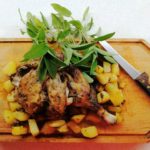
This way of roasting lamb is incredibly simple but involves some degree of organisation, since you need to calculate the time needed for marinating and cooking.

This a very traditional Tuscan recipe, celebrated in Pellegrino Artusi’s Science in the Kitchen and the Art of Eating Well. In those days, preparation snd cooking times, and ingredient quantities were rarely indicated, so I am trying to give more precise indications.

This Arezzo style roasted lamb is usually cooked on the BBQ, and is frequently basted with the marinade: in Italy we use a rosemary sprig as a brush.

This recipe’s ideal side dish is an oven dish full of golden potatoes, roasted with olive oil, garlic and sage.

Cook them apart, not in the same baking dish as the lamb, since the sharpness of the vinegar would give the potatoes an acidic taste.

Prep Time: 10 minutes | Cooking Time: 1 hour | Total Time: 1 hour + 10 minutes ( + 2 hours for marinading) | Yield: Makes 4 servings.

Ingredients


  • 2.5 lb (1 kg) lamb shoulder
  • 1 sprig rosemary
  • 3 sage leaves
  • 1 bay leaf
  • 2 garlic cloves, peeled
  • 4 tbsp olive oil
  • 2 tbsp white wine vinegar
  • Freshly ground black pepper
  • Sea salt


Instructions

Coarsely chop the herbs and add the olive oil and vinegar. Poke holes in the meat with a fork to absorb the marinade and let it sit for 2 hours.

Bake in a convection oven at 375° F (190° C) for an hour, turning and brushing it with the marinade (using a rosemary sprig).

Serve with sage and garlic roasted potatoes.


SWEET AND SOUR BORETTANE ONION

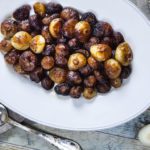
This side dish was created in Emilia, and it is the perfect complement to a vast variety of roasted meats, such as beef braised in Barolo wine.

It is a unique side dish, rich in fibre without the boring stigma associated with “healthy” foods.

In order to peel the onions, I found an American recipe that blanches them in a pot of boiling water followed by immersing them in a bowl of cold water to stop them from cooking. The temperature shift makes them easier to peel. In Italy, I usually find them peeled.

Prep Time: 5 minutes | Cooking Time: 25 minutes | Total Time: 30 minutes | Yield: Makes 4 servings.

Ingredients


  • 1 kg – 2.2 lbs Borettane onions, peeled
  • 60 g – 1/3 cup sugar
  • 300 g – 1½ cups water
  • 150 g – ¾ cup balsamic vinegar
  • 3 tbsp olive oil


Instructions


In a non-stick pan, heat the olive oil and add the onions. Brown the onions and add the sugar. Stir to melt the sugar, and when onions are caramelized add the vinegar and cook for a few minutes, until most of it evaporates. Add the water, stir gently and cook for 10 minutes, then cover with a lid and cook for 10 more minutes.

Test with a fork; the onions are ready when they are soft.


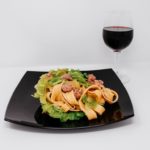
ROSEMARY NOODLES, SAVOY CABBAGE AND SAUSAGE.

This pasta recipe is quite rustic. Savoy cabbage and Italian sausage give a robust quality to this dish, and you can play with different flours. In this case I prefer blending durum wheat and pastry flour, in Italian a “00”, but also using whole wheat or buckwheat is an excellent choice. I do not love artificial colourings; I prefer to add mashed vegetables or aromatic herbs to the flour.

It is a very rich dish, and perfect from a nutritional point of view. If you open the meal with a very fresh salad, the balance will be perfect.

Prep Time: 30 minutes | Cooking Time: 30 minutes | Total Time: 1 hour minutes | Yield: Makes 4 servings.

Ingredients for pasta

  • 3 eggs
  • 1 + 2/3 cups (g. 200) pastry flour
  • ½  cup + 1 tablespoon (g. 100) durum wheat flour
  • 2 teaspoons of fresh rosemary, finely grinded

Ingredients for the sauce

  • 3 sausages (350 g. about 12 oz.)
  • 1 small Savoy cabbage
  • 1 small onion, finely chopped
  • 3 tablespoons olive oil
  • Marine salt


Instructions for pasta

On a wooden pastry board pour the flours in a mound, make a hole at its center and pour the eggs in it. Join the rosemary. Mix, make a dough that you are going to roll out by hand using a rolling pin.  Roll the dough into a sheet about two mm. (1/24-inch) thick.

While pasta is drying, prepare the sauce.

Instructions for the sauce

Put a big pot with salted water on the stove. Wash and core the cabbage leaves (about half of the cabbage).

In a wok, simmer the onion with the oil.

Peel the sausages, chop them in small chops and join them in the pan. Simmer the ingredients together.

Boil the cabbage leaves for a couple of minutes, and then put them in a bowl with water and ice.

Core and shred the leaves. Join them to the sauce.

Sprinkle the pasta dough with durum flour and roll it. Cut it in stripes. If it does not dry, cut it with the tool.

Boil pasta in the same water where you boiled the cabbage and pour it in the wok with the sauce. Add a couple of tablespoons of boiling water, and mix all the ingredients together. Add a bit of olive oil before serving the pasta.


CERTOSINO CAKE, CHRISTMAS IN BOLOGNA

With the Bologna Certosino (Chartreuse cake) I want to introduce you to a typical Christmas cake of Bologna cuisine, with almonds, pine nuts, unsweetened chocolate and candied fruit. It is almost unknown out of Emilia-Romagna region: sadly, the fame of many regional cakes is clouded by industrial products, which I am not a great fan of.

This cake is called panspeziale (apothecaries’ bread) – a kind of gingerbread, since in Middle Age it was created and baked by apothecaries (speziali).

Later, the Bologna Chartreuse friars began to bake it, and it was named after them. Other scholars believe the origin of his name is due to “special bread” (pan spzièl ) in Bologna dialect.


After careful historic researches, in the summer of 2003, Bologna delegation of Academy of Italian Cuisine deposited at Bologna Chamber of Commerce, Industry and Agriculture, the official recipe of Certosino.

This one, nevertheless, is not the canonic recipe but my mum’s, since that, like in all families, there is always the addition of little personal touches.

Prep Time: 10 minutes | Cooking Time: 40 minutes | Total Time: 50 minutes | Yield: Makes 8-10 servings.

Ingredients


  • ¾ cup (100 g.) whole almonds, peeled
  • ¾ cup (100 g.) pine nuts
  • 1 cup (100 g.) dried figs, in chunks
  • ¾ cup (100 g.) raisins
  • 1-cup (100 g.) walnuts
  • 7 oz (g. 200) diced candied fruit mix
  • 21 oz. (g. 600) whole candied fruit (orange, cherries, cedar)
  • 1-tablespoon anise seeds
  • 1-teaspoon cinnamon powder
  • 3 tablespoons honey
  • 2 cups (250 g.) pastry flour
  • ½-cup (100 g.) white sugar
  • ¾ cup (80 g.) unsweetened cocoa powder
  • 1-teaspoon baking soda
  • Tepid water


Instructions

Heat the oven, 350 F. (180 C.)

In a bowl, combine all the ingredients, adding the diced mixed fruit, except the candied ones which must be left in a whole.

Pour the mixture in a baking pan, previously covered with parchment. Use the candied fruits to decorate the top of the mix and bake it for 40 minutes at 350 F. (180 C.).

Check with a wooden toothpick if it is cooked. If the stick is still wet, add 10 minutes.


POACHED PEARS IN RED WINE

Poached pears in red wine are a delicious dessert, which joins the pleasure to eat fruit in an unusual way and the possibility to offer a dessert lighter than usual. It is free from animal products and indulges even the pickiest palates or our guests who suffer from food intolerances.

Pears, red wine, sugar and spices join in a magic blending which evokes winter and evenings spent in front of a fireplace. Traditionally they were cooked in the oven, in an Aga. The smell invaded all the house, but even now, even if we cook them in a pot, the scent which pervades all the house is heavenly. It recalls the atmosphere of Christmas Markets and the mulled wine you are served there

If you want to add a more personal touch to this dish, you could serve the pears on a bed of custard or Mascarpone sauce, and pour the wine reduction on it. If you also add some wild berries you could give a kick to a dessert that tends to be very sweet.

In restaurants in Emilia-Romagna, they are frequently served with a zabaione mousse.

Ingredients

  • 4 pears ripe but firm
  • 1+1/8 cup (300 ml.) red wine
  • 4/5 cup (200 ml.) water
  • 1 cup (200 g) white sugar
  • 1 cinnamon stick
  • 3 cloves
  • ONLY IF YOU LOVE IT:
  • 2 star anises
  • 2 cardamom berries, crushed

Instructions

  1. Combine water, wine, and sugar in a heavy pot. Peel pears without discarding the stalk. Put apart.
  2. Bring the liquid to boil and add the spices, stirring until sugar dissolves. Remove from heat. Add pears to cooking liquid. Return cooking liquid to boil. Reduce heat to low; cover and simmer until pears are tender, basting occasionally with cooking liquid if necessary, about 10-15 minutes. Using a slotted spoon, transfer pears to a bowl.
  3. Strain cooking liquid; discard solids. Return cooking liquid to pot. Boil until reduced to a syrup. Chill until pears are cold. (Can be prepared 1 day ahead. Keep refrigerated.)
  4. Pour syrup over pears. I suggest serving them on a custard or Mascarpone, joining also some berries in order to give a kick to a very sweet dessert.

Anise star and cardamom are not used very frequently: they can be replaced by 6 2×1-inch strips lemon or orange peel (colored part only).


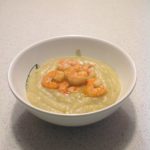
SEA POTAGE, A LACTOSE-FREE CREATION

Usually “potage” and “sea” contradict each other. This recipe is connected to “land” ingredients like potatoes, leeks, and a lot of fresh cream.

I created this recipe when trying to exalt Autumn vegetables, and trying to propose something healthy but extremely stimulating. I have always been inspired by French cuisine, but the recipe of the normal potage sounded really a bit too rich with all that cream. I decided to keep potatoes and leeks, add squash and a good fish stock and prawns, and I have to admit that it is very appreciated.

This encounter of fresh ingredients, poor in calories and rich in vitamins and fibers, is an excellent way to taste an unusual dish, light but full of taste.

In Italy, there are other dishes, mainly first courses, that enhance squash, like butternut squash gnocchi, the Ferrara squash ravioli, the Mantua ravioli. This vegetable is wonderful and versatile, rich in fibers, minerals and increases the sensation of fullness, helping a lot for the diets.

While in traditional Italian first courses squash is processed and squeezed, here the labor is extremely reduced; the addition of prawns and chili pepper balances the sweet note of squash and leeks.

Prep Time: 20 minutes | Cooking Time: 25 minutes | Total Time: 45 minutes | Yield: Makes 4 servings.

Ingredients

  • 16 oz. (500 gr.) potatoes, peeled and chopped
  • 24 oz. (750 gr.) butternut squash, deseeded, peeled, and cut into chunks
  • 2 leeks, only the white part finely sliced
  • 18 prawns with heads and shells
  • ½ cup + 2 tablespoons (120 ml) dry white wine
  • 1 small carrot, cut into chunks
  • 1 small onion, cut into chunks
  • ½ small celery stalk
  • 4 grains black pepper
  • Sea salt
  • 2 cups (500 ml.) water
  • 1 garlic clove
  • 2 tablespoons olive oil
  • 1 pinch chili pepper

Instructions

Prepare the stock simmering in a pot with the heads and shells of the prawns, vegetables, pepper, salt, water and wine for 30 minutes.

In a pot, sautè the leeks with 2 tablespoons olive oil. Then add the squash, potatoes and the filtered stock and boil for almost an hour; check the salt and season, eventually.

When the soup is cooked, mix the soup using an immersion blender, making a silky velouté.

In a non-stick pan, pour the oil and sauté the garlic clove in it. Discard the garlic and sauté the prawns, when they are roasted add the wine. Season with chili and salt.

After the wine has evaporated, pour the soup in the bowls and add 3 prawns for each serving.