PIGNOLATA, THE CHRISTMAS TRADITION

pignolata struffoli

Pignolata, also known as Struffoli in Naples, is a very popular dessert in Southern Italy, an area that was dominated by Spain for centuries, and its origin is from the region of Andalusia.

These Christmas marble-sized honey fritters are deep-fried and then rolled in honey before being assembled into a cone or a globular wreath.

This dessert belongs to the tradition of “peasant cooking”, and it is about customs, celebration, and sweetness. I decided to make Pignolata for my husband, as it was one of the few Calabrian dishes his mother made that he loved.

Like many Italian Christmas dishes, these fritters are the fruit of a collective effort, of many generations around the kitchen table working together. Rolling these little balls is child’s job, as their little hands are particularly apt to it.

This simple version, with no candied fruit, glacé cherries, or almond dragées is typical of my husband’s family. In other far richer cities like Messina in Sicily, this simple version was despised by the rich. For them, the local pastry chef created a double lemon and chocolate frosting, which could suit the more demanding palates (and bigger budgets) of aristocratic Sicilians. In Naples, the decoration is very multi-coloured, a real visual joy, full of all the most coloured candied fruit and silver dragées.

If you prefer something a bit more original, try the red raspberry version.

Prep Time: 60 minutes | Cooking Time: 30 minutes | Total Time: 90 minutes | Yield: Makes 12  servings.

Ingredients

For the dough

  • 4 ¾ cups (600 g) all-purpose flour, plus more for rolling
  • 6 eggs
  • A pinch of salt
  • ¼ cup (60 ml) Anise or Sambuca liqueur
  • 4 tbsp white sugar
  • 1 organic lemon zest, finely grated

For finishing

  • Vegetable oil (sunflower) for frying
  •  28 oz (800 g) honey

Preparation

Mix all the ingredients (except the honey and vegetable oil) in a bowl, you can use a stand mixer with a dough hook. Work the dough until it is smooth. This doesn’t take very long: about 3 minutes or 5 minutes by hand.

Let it rest in the bowl, covered with plastic wrap, for 2 hours.

Flour your work surface and turn out your dough. Then divide the dough into 10 roughly equal pieces, each about the size of a golf ball. Take 1 ball and roll it out into a rope approx. 1/2 inch thick, then with floury hands, divide this into about 20 small pieces, and roll each piece between your hands (flouring them again if this helps) to make marble-sized balls.

Fry them (deep frying) in small batches until they are golden and lay the marbles on kitchen paper. When you have finished frying, discard the oil and clean the pan with kitchen paper.

Pour the honey in the pan and, when the honey is warm, tip all of the fried dough balls into it and, using a soft spatula, turn them gently to coat them.

Get out a large plate or cake stand with a slight lip or rim and place a wet glass or a pastry ring on it. Arrange the balls in the shape of a pyramid or a wreath with a serving spoon.

MALTAGLIATI PASTA

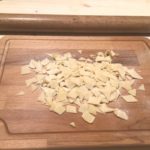
Maltagliati pasta - badly cut pasta

Maltagliati pasta is a very traditional shape in Emilia-Romagna, used for rustic soups like pasta & chickpeas or pasta & beans. Literally, its name means “badly cut”.

All good Italian housewives never waste food and this pasta is made from the remnants of dough cut for other shapes. When you roll pasta dough with a rolling pin you get an irregular shape, when you wrap it in a roll in order to cut fettuccine, or squares for tortelli, you cut the irregular edges.

I set the remnants aside, pile them up one on top of the other, and cut diagonally, first in one direction, then in the other, creating very irregular diamonds. I even cut small pieces into smaller ones by hand.

I then let them dry for an hour and freeze them in a bag.

If you need to make them from scratch, this is the recipe for 4 servings:


Prep Time: 15 minutes | Sitting Time: 2 hours minutes | Total Time: 2 hours and 15 minutes | Yield: Makes 4  servings.

Ingredients


  • 7 oz (200 g) all-purpose flour
  • 2 eggs

Instructions


On a wooden pastry board, pour the flour into a mound, make a hole in its centre and pour the eggs in it.

Mix by hand to make a dough that you are going to roll out using a rolling pin.

Let the dough sit for at least 30 minutes, wrap it in cling film or, even better, cover it in a glass bowl.

Roll the dough into a sheet about two millimetres (1/24-inch) thick. Let it dry for at least an hour and 1/2.

Flour it lightly, fold a few times to form stacking layers and, using a knife, cut fettuccine about ½ inch wide.

Follow the instructions above.


PASTA & BEANS, TRADITION AND VERSATILITY

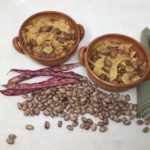
Pasta & beans, pasta & fagioli

Pasta e fagioli (pasta and beans) is a very typical Italian soup, simple, easy, yet incredibly versatile, as it is prepared many ways all across Italy.

For thousands of years, beans have nourished people from every social class, but its richness in proteins allowed the survival of the most of population who could not afford meat. Every region and corner of Italy has a version of this kind of soup, the simplest soup. It is prepared with an incredible set of variations: with the trinity of onion, carrot and celery, the fundamental ingredients of the majority of Italian sauces and stews; just simply with sliced onion and tomato in order to highlight the flavour of the beans, or parsley, or rosemary. In every Italian town and family there is always the addition of a personal touch.

Yet, despite its modesty, it is considered a comfort food, nourishing, simple but heart-warming.

This recipe is the one I rely on as a Romagnola, and I used it to civilize my husband: he had never eaten beans and soups before meeting me, and since he was such a carnivore, my trick was to blend all the vegetables and add some pancetta or ham to disguise the vegetables. It was like a kind of weaning.

Nowadays, sometimes my pasta e  fagioli (the Italian for pasta & beans) is vegan: I often refer to a recipe I was given in Le Marche region by a restaurant owner/chef, which used just onion and tomato for his soffritto. Then of course you follow the recipe as usual. I always have a supply of frozen maltagliati (fresh egg pasta) in my freezer, but if I use dried pasta, I even create a vegan and even lighter dish.

If I am using fresh pasta which cooks quickly, I cook it in the soup directly, in which case some attentive stirring is in order or the pasta will stick to the bottom of the pot. If you prefer using dried pasta – you should  cook it separately and then add it to the soup.

The only tricky part of making this dish is remembering to soak the beans, which if you are me, can be quite tricky, but is most satisfying when you remember. Then you need to remember to cook them, at a gentle simmer for at least a couple of hours while you spend  your time reading everybody’s latest posts. You can use tinned beans. but then you will miss the water the chickpeas were cooked in which provides agreat stock for your soup.

Usually, in most cookbooks, the beans and the soffritto are cooked in 2 different pots, whereas, since washing too many dishes is against my religion, I use always the same one.

Prep Time: 10 minutes | Cooking Time: 40 minutes | Total Time: 50 minutes | Yield: Makes 4  servings.

Ingredients


  • 250g dried chickpeas soaked overnight OR 700g fresh Romano beans
  • ½ onion, finely chopped
  • 2 garlic cloves, finely chopped
  • 1 small carrot, finely chopped
  • ½ celery stick, finely chopped
  • 50 g fresh pancetta or pork jowl, diced
  • ½ cup (130 g) tomato puree
  • 4 tablespoons cup olive oil
  • 6 cups (1.5 L) water
  • 200g maltagliati pasta (fresh pasta) or ditalini

Instructions


In the pot, sauté the vegetables in olive oil, and after 2 minutes, add the pancetta or pork jowl. Cook for 5-6 minutes on medium-low heat.

When the soffritto is golden, add the tomato puree and simmer for 15 to 17 minutes. Add the beans and 4 cups water (1 L water). Season with salt and let it cook, simmering. It takes about 80 minutes if you decide to cook with a normal pot; if this is the case, I strongly recommend a cast iron pot. In a pressure cooker it takes 20 minutes.

In the cast iron pot, you’ll have probably to add the rest of the water, or even more. Just add it gradually. Preferably hot, or you will lower the cooking temperature and it will take longer.

When beans are cooked, remove a ladleful of beans with some liquid and blend with an immersion blender in a container and add it back to the pot. It will give the soup a creamier texture without adding cheese.

Add pasta and follow the indications for cooking time.

When it is cooked, let it sit for 3 minutes and serve.


FLAT BREAD WITH GRAPES

schiacciata con l'uva - flatbread with grapes

Around the time of the grape harvest in Tuscany, in all Florentine bakeries you can find a very popular dessert, flat bread with grapes (schiacciata con l’uva). This a seasonal dessert made with bread dough, , olive oil, rosemary and grapes. Some recipes include red wine, finely chopped rosemary and anise seeds. I prefer a simpler version, in which I heat the oil with a sprig of rosemary at a very moderate power (oil must not fry) and use the rosemary as a brush.

It’s an excellent dessert when fresh, like all leavened cake, based on bread dough, the day after tends to get rubbery, so my advice is warming it up for few minutes in an electric oven.

Prep Time: 35 minutes | Cooking Time: 25 minutes | Total Time: 1 hour | Yield: Makes 8  servings.

TIP – rising time: 4 hours for rising

Ingredients for the dough


  • 4⅓  cups pastry flour
  • ½ cup white sugar
  • 5 tbsp delicate olive oil or seed oil
  • 1 sprig of rosemary
  • 0.35 oz fresh active yeast or ½ packet instant yeast (1 tsp)
  • 1¼ cups warm water
  • A pinch of sea salt

Ingredients for the filling


  • 2 lbs red concord grapes
  • 3 tbsp olive oil
  • 3 tbsp cane sugar


Instructions 


In a large bowl, dissolve the yeast in the warm water and add the sugar, then mix in the oil and the sifted flour. Add the salt last.

The dough must be very soft and sticky. In order to work it, you should spread some drops of oil on your hands.

Spread a tablespoon of oil on the dough and fold the outer edges into the centre as you turn the bowl. Let it rest for 15 minutes, covering with cling wrap.

Again, spread a tablespoon of oil onto the dough and repeat folding. Let it rest for 45 minutes, covering with cling wrap.

Repeat, and let the dough rest for 2 – 3 hours, until the dough has doubled in size.

Heat the oil with a sprig of rosemary and prepare a baking tray with parchment paper. Brush it with the flavoured oil using the rosemary sprig, and sprinkle a tablespoon of cane sugar on it.

Pre-heat the oven to 480 F (250 C).

Divide the dough into two parts. Place a piece of it on the prepared parchment, using your fingers and not a rolling pin to flatten it out, but not too thin. Brush with a tablespoon of oil, sprinkle with sugar, and spread with half of the grapes.

Repeat and lay the other half of the flattened dough on top, using your fingers to seal the edges. Again, brush with a tablespoon of oil, sprinkle with sugar, and add the remaining grapes.

Lower the oven temperatures to 430 F (220 C) and bake the flat bread for 20-25 minutes. Test for doneness with a toothpick. Let cool, and serve.


TANGERINE GELO: A SICILIAN INNUENDO

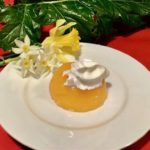
Tangerine gelo. The mere mention of this dessert evokes a sensation of freshness, citrus scents, and summer nights. Tangerine gelo is a typical recipe of the Sicilian tradition. Whereas its origin has been lost over time it likely has its roots in the Arab-Norman domination, so rich in creativity, pervaded by the scent of oriental spices and citrus fruits. Before the advent of corn starch carob flour was used as a thickening agent.

This tangerine gelo is a very simple and light dessert that uses fresh fruit, offering you the opportunity  to create a dessert that is fresh, seasonal, vegan and perfect for avoiding all kinds of food allergies and intolerances. The use of corn starch adds thickness to the gelatine since traditional gelatines do not work with acidic ingredients. Moreover, not only do you avoid using ingredients of animal origin, but you also enjoy the freshness of tangerines. The same basic recipe can easily be turned into other gelatines with other seasonal fresh fruits, like watermelon and melon in summer, or even with cinnamon.

The tangerine is quite sweet, but the addition of lemon adds an acidic note that is offset by the piped decoration. If you are lactose intolerant, substitute the whipping cream with the lactose free variety, or with sugar pearls if you are vegan.

Prep Time: 10 minutes | Freezing Time: 4 hours | Total Time: 4 hours and 20 minutes | Yield: Makes 2 servings.

Ingredients

For the gelatine

  • 45 g (⅓ cup) corn starch
  • 1 kg (2.2 lbs) tangerines, juiced and filtered
  • 1 lemon, juiced and filtered
  • 55 g (¼ cup) white sugar

For decorating

  • 125 ml (½ cup) fresh whipping cream
  • 20 g  (3½ tbsp) powdered sugar, sifted

Instructions

Pour all the ingredients except the corn starch in a saucepan and put it on the stove. Simmer over low heat for 3-4 minutes, until the sugar has completely dissolved. Add the corn starch, sifting it directly into the saucepan and mix thoroughly.

Pour into glass bowls and let them set in the fridge for at least 4 hours.

For the decoration, chill a medium mixing bowl and whisk in the freezer for 10 minutes before beginning. In the chilled bowl, whisk the whipping cream until it begins to foam and thicken. Add the powdered sugar and continue to whisk until soft peaks form. Do not over-whip. Pour into a pastry bag and decorate the top of the gelatine.


TWO TOMATO JELLY

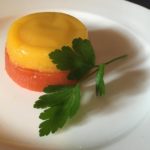
What inspired me to make this tomato jelly was the need to prepare something healthy, with local ingredients, and because of my family’s cholesterol test results. It is ideal for a dinner with a big group because in can be made a day or two in advance, and it can make all our dining companions happy: it is vegetarian, vegan, gluten-free, lactose-free….and light.

The xanthan gum is not essential, it is just a stabilizer and makes the colours more vivid, but it can also be a strong laxative if you overdo it, so be careful or avoid using it.

The addition of fennel and Sambuca liqueur is a touch of Rome, suggested by visiting Chef Fabio Campoli at the Florence Metro Academy.

Prep Time: 5 minutes | Cooking Time: 25 minutes | Total Time: 30 minutes | Yield: Makes 4 servings.


Ingredients


For the yellow jelly

  • 14 oz (400 g) yellow cherry tomatoes
  • 1 oz (20 g) onion, finely minced
  • Some wild fennel leaves
  • 1 tbsp Sambuca (star anise liqueur)
  • 1 tbsp olive oil
  • 1 pinch xanthan gum
  • 1 tsp agar-agar

For the red jelly

  • 14 oz (400 g) red cherry tomatoes
  • 1 tbsp olive oil
  • 2 garlic cloves, peeled
  • 1 pinch chili pepper
  • 1 tsp agar-agar
  • 1 pinch xanthan gum


Instructions


In a saucepan, sauté  the onion in the olive oil and add the yellow tomatoes when the onion is golden. Add salt, cook for 10 minutes and add the Sambuca and fennel. Add the agar-agar and the xanthan gum and mix carefully.

Wet 6 small moulds and pour the liquid into each of them through a sieve. Place the moulds in the fridge and let cool for an hour.

In another saucepan, sauté the garlic cloves in the olive oil. When they are golden, discard them and add the red tomatoes. Add the chili pepper, season with salt, and let it simmer for 10 minutes.

Add the agar-agar and the xanthan gum and mix carefully. Remove the moulds from the fridge, Pour the liquid into each mould through a sieve and put back in the fridge.


ALMOND COOKIES, THE TUSCAN CANTUCCI

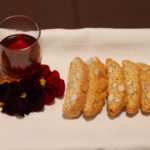
These almond cookies are the quintessence of Tuscan food. They are extremely simple, and the goodness of this recipe relies on the choice of quality ingredients.

I always make them on a wooden board because I love the sensation of working with dough, even if it is easier to use a food processor.

It likely began as a bread-like dough, a natural sourdough that was at the foundation of all European cakes, enriched with eggs and honey or very expensive cane sugar and almonds, which were introduced to Italy by the Arabs, whose presence or contact was constant for centuries.

This is a common recipe in Western culture, with some differences due to regional variations, but these cookies are very popular, known as biscotti in North America, probably imported by Italian immigrants. The recipe is very similar all over Italy: in Sicily they are simply called almond biscotti,  pepatelli in a more rustic version in the Southern region of Molise, but here the recipe is even closer to what must have been popular during the Middle Ages thanks to the presence of black pepper, orange zest, honey, and no baking powder.

I particularly love the Tuscan version because it offers a lactose-free dessert for my guests, and they are very low-fat, perfect if you need sugar to burn immediately


Prep Time: 10 minutes | Cooking Time: 40 minutes | Total Time: 50 minutes | Yield: Makes 90 pieces.

Ingredients

  • 500 g (3⅓ cups) all-purpose flour
  • 400 g (2 cups) white sugar
  • 3 large eggs
  • 60 ml (¼ cup) Vin Santo
  • 15 g (1½ tbsp) baking powder
  • 300 g (2 cups) unpeeled whole almonds


Instructions

Preheat the oven to 180° C (350° F)

Knead all the ingredients together and shape into 4 rolls about 30 cm (12 inches) long, and 5 cm (2 inches) wide. Place them on a cookie sheet lined with parchment paper. Bake them for 30 minutes. When cool, slice the logs diagonally. Spread the slices out and bake for 10 minutes


MARCHIGIANA RABBIT STEW

This rabbit stew (the rabbit can be substituted with chicken) is a vintage dish. I found it in a 1970s collection of recipes from an elementary school project in Pergola. Each child was asked to bring one of their grandmother’s recipes to school to assemble a traditional regional cookbook.

Pergola is a tiny hillside village in the heart of the Marche region, a beautiful area that is unfortunately or fortunately out of the tourist mainstream, where a local first-class cuisine still thrives.

In an age where there was no intensive livestock farming in Italy, we followed the seasons for meat consumption so, the end of summer was the best moment to eat rabbit, since those born during the spring had fully grown.

Toss the wonderful fresh home-made noodles with the stew’s sauce in a bowl adding a few tablespoons of the pasta cooking water.

Prep Time: 30 minutes | Cooking Time: 90 minutes | Total Time: 2 hours | Yield: Makes 8-10 servings.

Ingredients


  • 2 rabbits, chopped into small pieces
  • 2 cans of tomato purée
  • 2 onions, finely minced
  • 2 carrots, finely minced
  • 1 celery stalk, finely minced
  • Rabbit liver, finely chopped
  • 1 tbsp parsley, finely minced
  • 2 slices pancetta or prosciutto, finely chopped
  • ½ cup (125 ml) olive oil
  • 3 cups (750 ml) water
  • Salt and pepper
  • Fresh tagliatelle (noodles) 800 grams


Instructions

Place the rabbit pieces in a non-stick saucepan and sauté them until their water content evaporates, about 15 to 20 minutes.

When they are cooked, add all the other ingredients except for the water and tomato, and sauté for 25 to 30 minutes at medium-low heat. Season with salt and pepper and when the vegetables and pancetta are browned, add the water and cook for an hour, then add the tomato and cook for 30 minutes.


ROMAN-STYLE CHICKEN WITH BELL PEPPERS

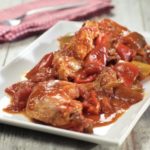
This chicken with bell pepper recipe is truly a typical summer one. The lively colours of the peppers and tomato create a unique blend that you can really appreciate only if you can find fresh sun ripened vegetables.

It is a typical Roman dish, and there is a whole generation of Roman’s who are in their sixties that can still remember meals eaten on the beach, with their mums bringing this pot wrapped in a dish-cloth.

Nowadays, modern recipes add more ingredients, rosemary, sage and garlic in the chicken, and later bell peppers are added in the same pot.

I preferred following an “old school one”, I do not like the idea of adding rosemary and sage to peppers, I think that my recipe is simpler but better.

If you are interested in watching a short video shot in the 1960s, you’ll find some scenes interesting to watch. Do not even make the effort to try to understand it, the cook speaks with a “Roman dialect”, and do not even think of touching or biting vegetables and fruits in the market, or the police will fine you and the vendor… hygienic rules have changed a lot since then.

I love the idea of cooking the meat and the vegetables apart, and joining them in the last 10 minutes of cooking.


Prep Time: 30 minutes | Cooking Time: 2 hours | Total Time:  2 hours and 30 minutes | Yield: Makes 4 servings.

Ingredients

  • 1 medium-size chicken, chopped into pieces
  • ½ medium onion, finely chopped
  • 3 bell peppers, red or yellow, chopped.
  • ½ glass of white wine
  • 7 tbsps. EVO oil
  • 1 tin  finely chopped tomatoes

Instructions

Brown the chicken pieces in a heavy pot with 4 tablespoons of olive oil. Once the meat is golden brown, add the wine and season the meat with salt and black pepper. Allow the wine to evaporate. It is important to add salt and pepper with the wine because it enhances the flavour and you use less salt. Wait until the wine has completely evaporated before adding the chopped tomatoes. Cook over medium low heat for a couple of hours with the lid on, and add some water or stock if needed.

In another pot sauté the onion with the remaining  oil, and when it becomes golden add the peppers. Season with salt and black pepper. Cover with the lid and let it cook for half an hour. Remove the lid and let it cook for another 20 minutes, then add them to the pot with the chicken and cook meat and peppers together for 15 minutes.


CHICKPEA FLATBREAD: THE CONQUEST OF THE TYRRENIAN SEA

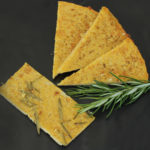
Chickpea flatbread is a humble but delicious dish, with its origins dating back to ancient Greek and Roman times.   On the Tuscan coasts it is called Cecina, Farinata in Liguria, and is a common dish on the coasts of the Mediterranean, where it was spread by Ligurian sailors.

Porridges and legumes were commonly in use in the Ancient Mediterranean, and it is now common knowledge that this recipe was introduced during the Middle Ages by the Maritime Republics of Pisa and Genoa. The legends which recount the birth of this recipe are fascinating: the first narration recalls the siege of Pisa in 1005, when the Pisan fleet was in Calabria to help its inhabitants, which had been attacked by Saracens. Some Arabic vessels pointed North and assaulted Pisa. Its desperate citizens reacted to the attack, hurling anything they could grab on the attackers. Almost anything was hurled on the heads of the Saracens, furniture and food too; sacks of chickpeas, which were stepped on and mixed with boiling olive oil, among other things.

When the attackers left, the hungry citizens tried to salvage their properties, and the chickpea flour, which had been mixed with olive oil. At the time, wasting food was not an option, and the citizens tried to recover the slop, which had dried in the sun. The citizens called it “Pisa gold” referring sneeringly to the attempts of the Arabs to seize the city’s riches.

Another legend refers to an ensuing battle, the one in Meloria in 1248. Genoa won over Pisa and took the Tuscan sailors as hostages. The Ligurian galleys were involved in a storm, and the sacks of chickpeas and vases of olive oil were thrashed in the hold and mixed with sea water, making a slop which was served to the sailors in wooden bowls. Some of them refused to eat it, but the bowls were left in the sun, which dried and cooked the gruel, making a delicious dish.

Another version tells of the effort to spread the slop on sea rocks, in order to dry it, but the result was still the same; the following and decisive result is added by the cooking the mixture  in a wood burning oven, which is the real secret of its excellence.

Prep Time: 5 minutes | Cooking Time: 25 minutes | Total Time: 30 minutes + 5 hours standing | Yield: Makes 4 servings.

Ingredients


  • 1 1/3 cups (150 g.) chickpea flour
  • 1 teaspoon sea salt
  • 4 tablespoons olive oil, 2 for the batter and 2 for the pans
  • 2 cups water, room temperature
  • black pepper
  • 1 baking pan, in steel or copper, diameter 13 inches (32 cm)


Instructions


In a bowl, gradually mix the flour with water, cover with a film and let it sit for 4-5 hours, mixing it every half hour.

The flour will produce impurities which make a kind of foam and must be discarded, using a slotted spoon.

This procedure is used in Liguria, the Tuscans are much quicker and mix all the ingredients together almost immediately and bake them, without the sitting time.

After the resting time, add salt and olive oil to the mixture and pour it into a baking pan, and put into a pre-heated oven at 425 F (220 C) for 10 minutes in the lower part of the oven, then move it to the upper part and cook for 10 to 15 minutes, until it is light brown.

An excellent addition can be spring onion, fresh parsley, Italian sausage, or aromatic herbs like rosemary, mixed to the batter before baking them, together with salt and oil.