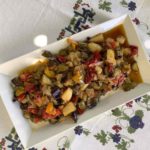
APULIAN CAPONATA

Summer vegetable stew

This Apulian caponata is a version of this one of Sicily’s essential dishes. It is a vegetarian eggplant stew–more like a relish, really–made of eggplant, onions, bell pepper, celery and tomatoes with briny olives and capers.

There are variations of this tasty eggplant dish. Most of caponatas are spiked with vinegar or raisins.

This version was given to me by a dear friend who lives in Prato, but she owns her Apulian origins a fantastic touch with veggies. This ratatouille is baked, and much lighter then the original version with fried veggies.

The addition of Juniper berries and bay leaves to caponata confers it a very unusual taste which, surprisingly enough (usually these herbs are used in game or meat cooking), melts perfectly with this tasty deli.

It is best the next day, so try to make it ahead and store it in the fridge in a tight-lid mason jar. Bring it to room temperature before serving.


Prep Time: 20 mins | Cooking Time: 60 mins | Total Time: 1 hour + 20 mins minutes | Yield: Makes 8 servings.


Ingredients 

  • 4 medium yellow onions
  • 1 yellow bell pepper
  • 1 red bell peppers
  • 3 medium potatoes
  • 1 large eggplant
  • 125 ml (½ cup) EVO oil
  • 10 bay leaves
  • 1 tablespoon black peppercorns
  • 1 tablespoon Juniper berries
  • Sea salt

Instructions


Cut the eggplant in chunks, sprinkle with salt and let drain in a colander.

Halve and deseed the peppers, then roughly cut into large chunks. Do the same with potatoes and zucchini.

Heat oven to 180C/170C (350 F) fan.

Cover two shallow roasting pans with parchment paper, pour in the vegetables except the eggplant, and season with salt.

With a clean tea towel, squeeze the eggplant chunks and add them to the other vegetables.

Spoon two-thirds juniper berries, peppercorns and olive oil and bay leaves (roughly broken into two halves) into the vegetable mixture, toss together, then roast for 40 minutes.

While vegetables are baking, cut the onions in two halves and then into strips.

Put them in a bowl, season with salt and the remaining herbs and olive oil.

After the vegetables have cooked for 40’, add the onion, mix and let it cook for 20’, or until all the vegetables are soft.



ORVIETO, ITS CLIFF AND PIGEON BREEDING.

Orvieto is a beautiful Etruscan town built on a sheer cliff that is mainly composed of tuff and pozzolana, a soft material easy to excavate.

The Orvieto cliff was apt to being easily defendable thanks to its structure; meanwhile its inhabitants started to excavate its underground in order to obtain factories, storehouses and plants without distancing themselves from the powerful walls which defended the town.

Over the three thousand years of its history, the inhabitants bored more than one thousand cavities: I visited the widest, where there are the remnants of an oil mill and some millstones. Toward the interior of the cliff, the cavity is articulated in a series of rooms: among them, three Etruscan wells with their characteristic notches were workers who were excavating put their feet (pedarole in Italian). Another cavity, bordering with it, overlooks the cliff sides, and it is characterized by a great quantity of columbaria or dovecotes. These are rooms with a great quantity of recesses where pigeon could nest. This function is validated by the presence of water tanks and openings in the cliff edge to allow the pigeon keeper to give his animals liberty for purposes of exercise while allowing them to re-enter the house without special assistance from the keeper. At the same time, these houses are constructed to keep the pigeons safe from predators and inclement weather and give them nesting places in which to raise their squabs.

Pigeons were especially prized because they would produce fresh meat during the winter months when larger animals were unavailable as a food source. In the past wealthy landowners often had pigeon houses and there are still remnants of them in some European manor houses. Orvieto dovecots were especially useful in case the town were under siege and deprived of supplies of fresh food from the country nearby.


Prep Time: 15 minutes | Cooking Time: 1 hour + 35 minutes | Total Time: 1 hour + 50 minutes | Yield: Makes 4  servings.

Ingredients

  • 2 pigeons about 10-14 oz. (300-400 g.) each.

For the stuffing

  • 2 fresh Italian sausages, peeled OR 9 oz. (250 g.) ground pork generously seasoned with salt and freshly milled black pepper
  • 2 tablespoons fresh Pecorino cheese, grated
  • 1,5 oz. (40 g.) stale bread (Ciabatta-like), deprived of crust
  • 1 egg
  • ¼ cup milk
  • 1 tablespoon fresh parsley, finely minced

For the cooking

  • 3 garlic cloves
  • ½ cup dry white wine
  • 3 sage leaves
  • 4 Juniper berries
  • 2 sprigs of rosemary
  • 3 tablespoons olive oil
  • 2 slices pancetta

Instructions

In a small bowl, pour the milk and soak the bread in it. Squeeze the milk out of it, put it in a bowl with the meat, and mix it with all the other ingredients, using your hands.

Season the pigeons with salt and pepper and the Juniper berries lightly crushed, and then stuff them but not completely, since the stuffing will swell when cooking. Close the pigeon with a toothpick or needle and thread.

Pour the oil in a heavy saucepan and add garlic, rosemary and sage. Place the pigeons in it and pancetta on the pigeons. Pigeons tend to dry, so choose a saucepan that fits them perfectly, not too large.

Roast the pigeons in all their sides and simmer with the wine until reduced.

Make the pigeons simmer for about 1 hour, covered with the lid, and add some tablespoons of water if necessary.

Serve them still warm, cut in two halves. Great with mashed potatoes.