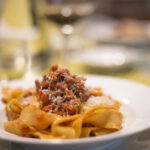
Tagliatelle alla Bolognese: A Legend of Golden Curls and Romagnolo Traditions
The Story: A Renaissance Obsession
In early 1502, Italy witnessed one of the most extravagant spectacles of the Renaissance: Lucrezia Borgia’s wedding procession. On her way to Ferrara to marry Alfonso d’Este, she traveled with a massive entourage of 600 horses, 150 mules, and a court of musicians and aristocrats.
The journey was famously slow, not just because of the logistics, but because of Lucrezia’s beauty routine. She was renowned for her long, shimmering blonde hair, which she insisted on washing every eight days. These “hair days” were no small feat—they required a full day of rest for the entire procession, much to the frustration of her father, Pope Alexander VI, who was anxious for the wedding to proceed. But for Lucrezia, her curls were her crown.
The Invention of the Golden Ribbons
As the procession passed through the lands of Bentivoglio in Bologna, the city’s lord commissioned his master chef, Zefirano, to create a banquet worthy of the bride.
Captivated by those legendary curls that had delayed a papal procession, Zefirano took a sheet of golden egg pasta and cut it into long, silky ribbons to mimic Lucrezia’s hair. He essentially created the world’s first Renaissance “egg-stensions.”Thus, according to legend, Tagliatelle were born—a dish created from an obsession with beauty.
Where Nobility Meets the Heart: Nonna’s Kitchen
But while a chef in a palace gave Tagliatelle their shape, it was the grandmothers in the countryside who gave them their soul. A pasta born from such a noble inspiration deserves a sauce with real character—not a delicate courtly cream, but a bold, deep, and honest Ragù.
This is where my Nonna from Romagna enters the story. If Lucrezia provided the elegance, my grandmother provided the heart. Her kitchen followed the strict, unwritten rules of the late 1800s. She didn’t cook for a princess; she cooked for a family that demanded flavor, substance, and tradition.
The Heritage of the Pot
My grandmother’s version is a tribute to the bold flavors of our land. She taught me that a great Ragù is an exercise in patience. It doesn’t start with the meat, but with the pancetta—it needs its own time to sizzle and render until golden.
While back in the late 1800s her recipe would have featured chicken hearts and livers (common “noble” scraps of the era) and a base of lard, I’ve refined it for the modern palate using high-quality Extra Virgin Olive Oil. However, I’ve kept her most important rule: No milk, and at least 3 hours of simmering. This is how you get that deep, glossy, concentrated flavor that stays true to our Romagnola roots.
The Authentic Recipe (Serves 4)
Ingredients
For the Pasta:
- 300g (approx. 2 ½ cups) “00” or All-Purpose Flour
- 3 Large Eggs
For the Romagnolo Ragù:
- 100g (3.5 oz) Cubed Pancetta
- 300g (10.5 oz) Ground Beef (coarse grind)
- 150g (5.3 oz) Ground Pork
- 50g each (approx. ½ cup) finely minced Onion, Celery, and Carrots
- ½ cup (120ml) Dry White or Red Wine
- 300g (10.5 oz) Tomato Purée (Passata)
- Extra Virgin Olive Oil, Salt & Pepper, Beef Broth (as needed)
Instructions
1. Homemade Tagliatelle
The Dough: On a wooden pastry board, mound the flour and create a well. Crack the eggs into the center. Gradually incorporate the flour, then knead for about 10 minutes until smooth.
- Pro Tip: Keep the dough close to your waist. Lean into it using your body weight and gravity rather than just your shoulders.
- The Rest: Wrap in plastic and rest at room temperature for 30 minutes.
Rolling & Cutting: Roll the dough until it is 1 mm thick. Let the sheet (sfoglia) air-dry on the board for a few minutes. It should be dry enough to not stick, but still elastic enough to roll without breaking.
- The Cut: Once you reach that perfect consistency, gently roll the sheet into a cylinder and cut it into ribbons (approx. 7mm wide) with a sharp knife.
- The Alternative: If you are short on time, you can cut the flat sheet directly using a traditional pasta pastry wheel(rotella).
2. The Romagnolo Ragù
The Foundation: Add a generous drizzle of Extra Virgin Olive Oil to a hot pot. Once the oil is hot, add the pancetta. Let it fry until golden and crispy—this base is the secret to the entire sauce. The Soffritto: Add the minced onion, celery, and carrot. Sauté until translucent and soft. The Meat: Add the beef and pork. Brown the meat thoroughly; this deep sear is essential for the flavor. (Note: Late 1800s recipes often cited chicken offal as a historical note, but we omit them for a cleaner, modern finish). The Simmer: Deglaze with wine. Once evaporated, add the tomato purée. Lower the heat to a minimum, cover, and simmer for at least 3 hours. Add broth if needed to keep it glossy. No milk is required.
The secret to these golden curls, inspired by the legend of Lucrezia Borgia, starts with the right grain. Want to know which flour creates the perfect texture? Read my Italian Pasta Map: A Guide to Choosing the Right Flour.
Now it’s your turn! 🍝
I’d love to see how your golden ribbons turn out! If you recreate this recipe, share your masterpiece and tag me in your photos or stories on Instagram.
Have a question about the “sfoglia” or the ragù? Let’s chat over on my latest Instagram post! I’m always there sharing tips and answering all your cooking curiosities. See you in the kitchen!
[Follow me on Instagram https://www.instagram.com/cookingwithcarlottainflorence/]